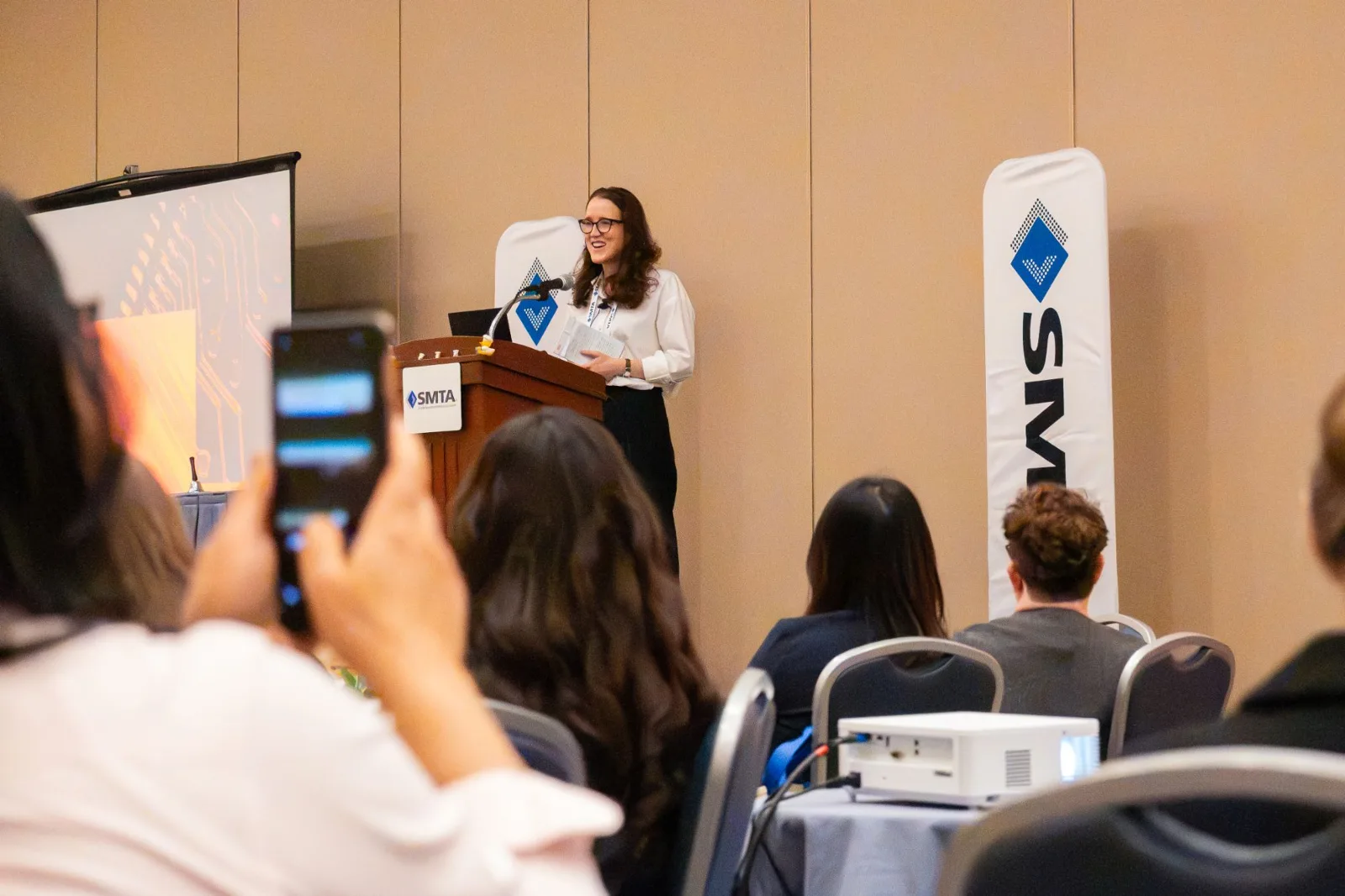
On Monday, October 26, 2026, BSU Electronics CEO Leyla Sudbury gave the keynote for the Women’s Leadership Program session at SMTA International, the national meeting of the Surface Mount Technology Association, in Chicago. Her talk, “Supply chain on a sprint: leading people (and AI agents) without a long runway,” covered the least glamorous and most important part of building electronics right now: getting the materials.
What does an electronics assembler actually do?
“What we do is take ideas and make them real in the physical world,” Leyla told the room. Some people picture that as assembling flat-pack furniture: parts arrive in a box, you follow the instructions. The reality has three parts:
- Shopping. Finding every part, comparing alternatives and responding every day to shifts in availability and cost, while getting the right trade-off between price, quality and speed.
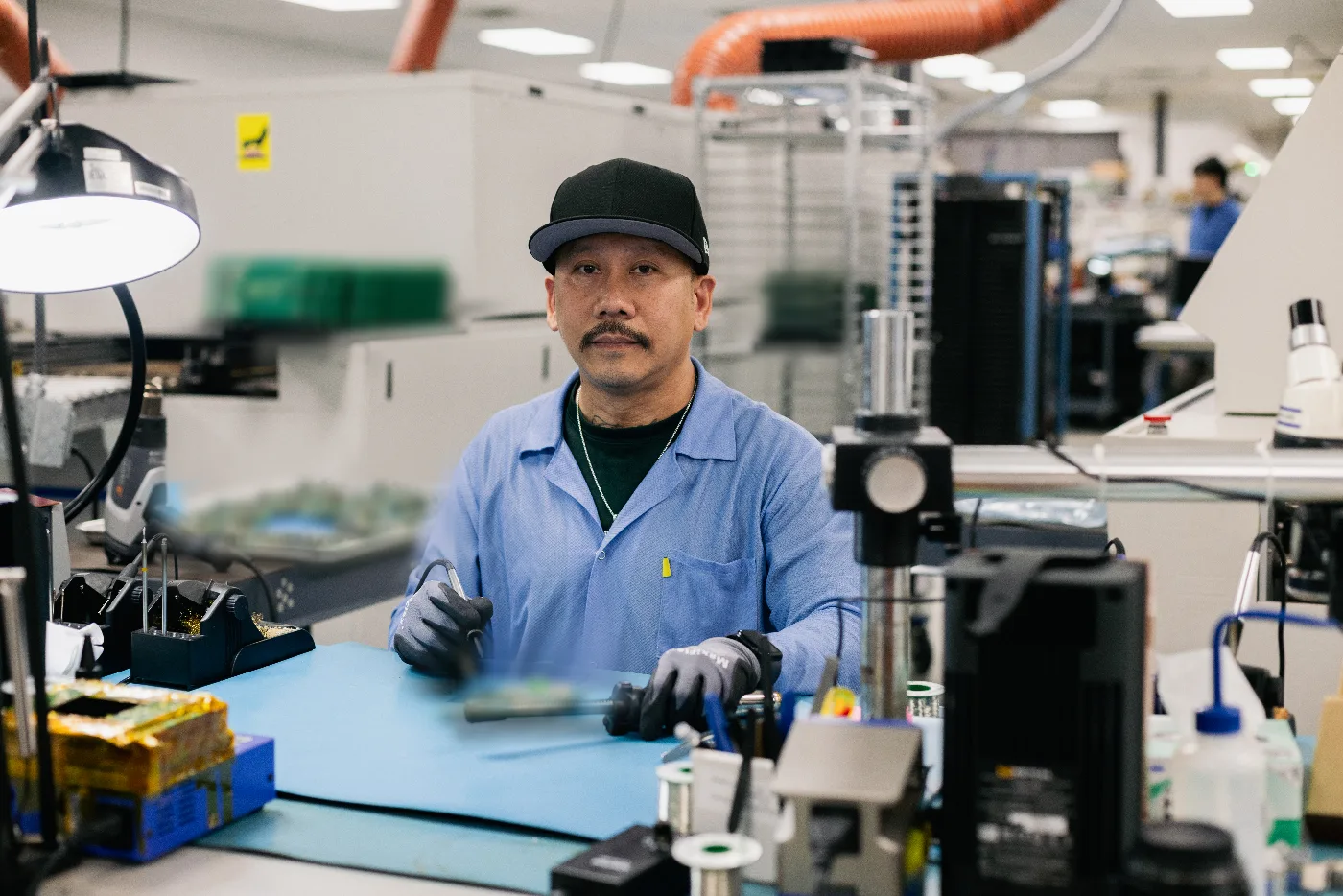
- Baking. Laying down solder paste, placing components, reflowing, washing, then inspecting and testing.
- Paperwork. Authentication from receiving to shipment, with every change order logged along the way.
The gap between “just assembling” and what an assembler actually does is widest in the shopping, and in the last year it got a lot wider.
Why is demand for U.S. electronics manufacturing rising?
Demand is coming from two places. First, U.S. manufacturers are shifting from efficiency to self-sufficiency: they want domestic supply chains, and in defense and government work they are increasingly required to have them. Some of that is the lesson of COVID; some is national security.
Second, AI is lowering the cost of intelligence. Ideas for new products are getting easier to generate, but it is just as hard to bring them into the physical world. The bottleneck is shifting from the idea to the build.
Hardware is coming back to America in clusters: optics in Rochester, defense and space in Huntsville and El Segundo, robotics in Pittsburgh and Boston, and chips, robots and defense in BSU’s home of Austin. US spending on building factories peaked in 2024. The new plants are finishing, and now they need boards, parts and suppliers. That is where the pressure shows up next.
Why are electronics supply chains so fragile right now?
Every country is doing what the US is doing. Governments are pushing for self-sufficiency and more control over the chokepoints they hold: India is subsidizing its own PCB and laminate factories, and Indonesia, the world’s biggest tin exporter, has considered halting tin exports so products like solder are made at home. Natural disasters are no longer the only thing that snarls supply chains; policy, conflict and export controls do too.
Bare boards show what that means in practice. The US producer price index for bare circuit boards has risen about 45% since December 2025, and standard bare board lead times have roughly doubled, from 2–4 weeks to 4–8. Four things collided:
- AI servers. Boards with three to five times the layers soak up high-grade laminate and factory capacity.
- Scarce inputs. Glass cloth, copper foil and resin are all short at once, and copper prices hit records.
- Conflict. The war in the Middle East disrupted resin supply and Gulf shipping.
- Slow to fix. New glass yarn and copper foil capacity takes years to build.
For customers, it shows up as much in lead times as in price, especially for prototypes and small batches.
How has BSU adapted? Find the long pole on day one
On a typical BSU NPI or short-run build, sourcing is about 80–85% of the lead time; build and test is the small sliver at the end. So BSU finds the “long pole in the tent,” the one part that sets the date, and works it first:
- Within the hour, a dedicated quoter opens the files and the BOM.
- Find the long pole. Today it is usually the bare board.
- Work it first. RFQs go out to board houses and suppliers the same day.
- Quote in 3–5 business days, with lead time and risks called out honestly. A quote with the wrong lead time is worse than a slow quote.
ITAR and non-ITAR quotes run in parallel on the same clock. ITAR work lives in a segregated environment with domestic-only sourcing, overseen by our lead compliance engineer.
BSU runs materials as one operating system: dedicated buyers who chase every open line, people full time on quotation, customer service that shares what it learns with customers early, and engineers directly involved, including a dedicated ITAR lead. A daily RFQ call troubleshoots new quotes, and a twice-weekly customer service meeting works through what changes mean for each customer. Suppliers have to meet BSU’s bar on quality and, where needed, ITAR eligibility before they are ranked on speed and cost.

What has AI changed in BSU’s quoting?
BSU started with a time study in early 2026, asking everyone what share of their time went on each activity, what they liked doing least, and what was most automatable. The overlap between the last two was almost perfect: between 20% and 30% of everyone’s time went on work they saw as automatable, and it was the work they liked least.
BSU’s first AI agent, Quentin, does quoting. It prices the BOM against suppliers, proposes pricing from recent context, complexity and lead time, and builds the quote. A named person reviews, corrects and approves every quote.
- Active time per quote: from about 20 hours to about 2, now almost all spent reviewing.
- First-cut quote accuracy: from 88–92%, depending on who did the quote, to a consistent 96%.
- Fastest quote so far: 8 minutes, start to finish.
It wasn’t all plain sailing. Capacity dipped before it rose, because the people most stretched are the ones who have to help build it. Leyla shared five learnings: get the team excited, start small, get process and data right first (“AI on a messy process just makes a faster mess”), raise accountability so a named person answers for every output, and bring in experts who design the failure modes in, including clear limits such as never touching ITAR data.
What should engineers and buyers do differently?
The one thing anyone can do on Monday: work with your supply chain early. Designers can design for availability. Buyers can approve alternates and release long-lead buys when they get the quote, not when they place the full order. And assemblers are stronger sharing signals on key parts than competing for allocation.
“The supply chain isn’t going to slow down for any of us,” Leyla closed. “But we get to decide how our teams feel running at that pace. Done well, it’s energizing, not exhausting.”
Sources cited in the talk include the US Bureau of Labor Statistics producer price index for bare printed circuit boards (via FRED), industry lead-time reporting, and BSU’s own quoting records and time study.
Frequently asked questions
- What did Leyla Sudbury speak about at SMTA International 2026?
- Her keynote, “Supply chain on a sprint: leading people (and AI agents) without a long runway,” covered why sourcing now sets the schedule for new electronics, how bare board prices and lead times have moved in 2026, how BSU finds and works the “long pole” on every quote, and what BSU learned building its first AI agent for quoting.
- Why are bare circuit board lead times longer in 2026?
- AI server boards with three to five times the layers are absorbing high-grade laminate, glass cloth, copper foil and resin are all short at once, conflict in the Middle East has disrupted resin supply and shipping, and new glass yarn and copper foil capacity takes years to build.
- How fast does BSU quote a new build?
- Within the hour a dedicated quoter opens the files and BOM, RFQs for the long-lead items go out the same day, and BSU quotes in 3–5 business days with lead time and risks called out. ITAR and non-ITAR quotes run in parallel.
- Does BSU use AI on ITAR work?
- No. ITAR work lives in a segregated environment with domestic-only sourcing, overseen by our lead compliance engineer. BSU’s AI tools never touch customer ITAR data.